
Designing Interiors with Adaptability in Mind across the Gulf
Designing Interiors with Adaptability in Mind across the Gulf Across the Gulf, design has always been driven by a combination of adaptation and aesthetics. In recent years, as the region has begun encountering shifting weather patterns, new consumer preferences and industry challenges, the role of interior fit-out design is fast expanding. Rather than being a secondary element in the built environment, fit-out design has now evolved into a strategic factor central to advancing the Gulf’s long-term climate resilience and shaping future-ready, high-performance interiors. Today, the way we design, construct, and maintain interiors directly impacts how well buildings can withstand environmental pressures while maintaining comfort for occupants. Modern interiors are increasingly engineered to handle higher cooling loads, regulate elevated humidity, and support efficient maintenance cycles, all while meeting the growing demand for sustainability. For fit-out professionals, resilience is no longer a luxury but a necessity. Beyond enhancing operational efficiency, it plays a key role in long-term cost management and asset longevity. As regional governments accelerate their sustainability and net-zero agendas, the fit-out industry’s ability to integrate climate-adaptive strategies will define its relevance in the coming decade. Sherif Nagy, Chief Executive Officer of ME Fitout, speaks about redefining fit-out excellence through innovation, sustainability, and client-focused design in the UAE Choosing the right materials is one of the most effective ways to adapt to extreme climate conditions. The Gulf’s harsh weather demands materials that can withstand heat, moisture, and corrosion without compromising on aesthetics. Studies on Gulf high-rise buildings have shown that even simple improvements to the building envelope and interior materials can cut energy demand by up to 60 per cent in existing structures and nearly 70 per cent in new ones. Thermally reflective finishes, corrosion-resistant metals, and materials with low volatile organic compounds (VOCs), that maintain air quality under constant air-conditioning loads, are becoming the new standard. As clients increasingly demand environmentally responsible solutions, the industry must focus on materials that balance durability, sustainability, and performance under extreme conditions. Even though fit-out work focuses on interior environments, designers have a surprising amount of influence on energy performance. Passive design principles such as smart partitioning to enhance airflow, reflective surfaces to reduce heat absorption, and integrated shading can significantly reduce the burden on HVAC systems. With urban heat islands intensifying across Gulf cities, every interior layout and material choice must now serve the dual purpose of aesthetic appeal and thermal efficiency. Meanwhile, the Gulf’s real estate market is evolving at an unprecedented pace. With progressive regulations, dynamic tenant expectations, and rapid technological advancements, buildings are becoming more responsive and future-oriented. As a result, interiors are now designed with adaptability in mind, enabling spaces to evolve sustainably as needs and innovations continue to arise. Modular joinery systems, raised flooring, and flexible lighting grids allow spaces to evolve with minimal disruption and waste. This flexibility improves operational resilience as well as supports environmental goals by reducing material waste over time. In a future defined by constant change, modularity is the foundation of longevity. Resilience in the Gulf region will also be powered by data. Smart sensors that monitor temperature, humidity, and occupancy patterns can automatically adjust lighting and cooling, maintaining energy efficiency while ensuring occupant comfort. IoT-enabled systems can even detect early signs of humidity-related issues, such as mould formations, before they escalate into major financial concerns. As high energy consumption remains a regional challenge, integrating technology into fit-out design is essential. These innovations align with the UAE’s Net Zero 2050 strategy and broader GCC sustainability goals, creating interiors that are intelligent, adaptive, and environmentally responsible. Leading fit-out firms in the UAE are shifting their focus from cost to value. This is because clients today are more aware of lifecycle costs, operational risks, and ESG commitments. A fit-out that demonstrates measurable energy savings, reduced maintenance needs, and climate-ready design meets compliance and also gains a clear competitive edge. In the years ahead, resilience will become a key commercial differentiator in the marketplace, influencing investment decisions and brand reputation alike. To future-proof interiors, fit-out specialists must embrace climate-risk modelling during the design phase, assessing how materials and layouts will perform under projected 2035–2040 conditions. Collaboration with suppliers who provide verified data on material performance in Gulf environments will be essential to ensure that sustainability claims translate into real-world durability. By combining passive design, modular systems, and intelligent monitoring, the Gulf’s fit-out industry has the opportunity to meet sustainability standards as well as set new benchmarks. In doing so, it will help shape a new era of resilient, climate-conscious interiors that adapt as the region’s vision for sustainability evolves. Published by: The Integrator View Article HERE
Clients Are Looking For Spaces That Reflect Who They Are
Clients Are Looking For Spaces That Reflect Who They Are With over 25 years of global experience across three continents, Sherif Nagy, Chief Executive Officer of ME Fitout, is widely regarded as one of the most transformative figures in the real estate and interior solutions industry. As the visionary leader of a company known for delivering high-end, turnkey interior fit-out projects across the Middle East, Nagy has been instrumental in elevating ME Fitout’s reputation through operational excellence, cutting-edge facilities, and a deep commitment to client satisfaction. In this exclusive conversation with REM TIMES, Sherif Nagy shares his insights on the evolving demands of the UAE’s booming fit-out market, the growing emphasis on personalization and sustainability, and how ME Fitout is strategically positioned to meet the future of interior design with precision, innovation, and purpose. Sherif Nagy, Chief Executive Officer of ME Fitout, speaks about redefining fit-out excellence through innovation, sustainability, and client-focused design in the UAE Q. The global interior fit-out market is projected to hit USD 89.15 billion by 2029, growing at a CAGR of 5.41%. What’s driving this momentum in the UAE specifically and how is ME FITOUT adapting to meet that demand? The UAE has always had an ambitious vision when it comes to infrastructure, urban development, and world-class design. That ambition is now accelerating. Regionally, we see that the UAE’s interior fit-out market is expected to reach a valuation of USD 4.13 billion by 2023, due to ongoing urban development, mega infrastructure projects, as well as a renewed focus on hospitality, healthcare, education, and commercial spaces. Furthermore, visionary frameworks like the ‘Dubai 2040 Urban Master Plan’ and ‘Abu Dhabi Economic Vision 2030’, as well as ambitious projects like the upcoming ‘Trump Tower Dubai’ are stimulating demand for world-class interiors. We cater to this rising demand by delivering multiple projects simultaneously with consistent quality control, leveraging the expertise of our dedicated team and our 100,000 sq. ft facility in Dubai Investment Park, one of the UAE’s largest and most advanced manufacturing facilities equipped with next-generation European machinery and advanced systems. Moreover, our ability to synergise automation with traditional craftsmanship sets us apart, enabling us to handle complex, high-profile, and bespoke projects efficiently. Q. In 2025, we’re seeing design trends tilt toward hyper-personalisation, smart tech integration, and wellness-driven layouts. What are the top client preferences shaping your projects today? With people spending more time indoors due to remote work or lifestyle changes, the demand for aesthetically designed spaces that cater to comfort, and functionality has surged. Aligning with this, designers are increasingly opting for neutral colour palettes complemented by bold, statement pieces, to create spaces that exude sophistication while maintaining simplicity. Moreover, design trends are also being shaped by client demands for personalisation as well as the rise of wellness real estate. We’ve noticed more of our clients looking for spaces that are not only functional but deeply personal — spaces that reflect who they are. Whether it’s a home, an office, or a retail environment, the demand is for spaces that feel authentic, not generic. A key trend is customization — from bespoke joinery to distinctive material choices that tell each client’s unique story. We’re also seeing a growing emphasis on integrated smart technology — but designed thoughtfully, so it enhances everyday living without compromising the warmth or character of the space. Another major focus is well-being. Clients are asking for layouts that maximize natural light, improve air quality, and create a stronger connection to nature — all while maintaining a refined, high-end finish. Alongside this, sustainability is becoming non-negotiable. Q. Reports show that sustainability is now a top priority in over 60% of new fit-out requests globally. How is ME FITOUT incorporating green materials or circular economy thinking into its workflow? Sustainability is no longer a trend; it is a core expectation and responsibility. At ME Fitout, we’ve made deliberate investments to ensure that our operations align with both environmental regulations and our own commitment to responsible manufacturing. Our high-tech, sustainability-driven facility is well organised and has an environmentally responsible waste management system, in line with Dubai Municipality regulations. This includes meticulous material segregation, wherein our housekeeping teams sort and store offcuts for reuse or proper disposal as well as sawdust collection using integrated vacuum lines to keep production areas clean and move the dust into a central unit for disposal. We also implement daily site cleanup, during which all leftover materials from site work are bagged and handed over to our waste management team. Reusable materials, on the other hand, are repurposed where possible, minimising waste, improving material efficiency, and driving sustainable operations. Furthermore, we leverage software-driven optimisation systems that reduce excess usage, highlighting our commitment to advancing sustainability and circular economy principles without compromising on quality or precision. Q. Luxury is second nature in the UAE, and clients today expect a flawless finish and distinct brand storytelling. How do you balance high expectations with realistic budgets and timelines? In a market like the UAE, where luxury is the standard and every space is expected to tell a unique story, there’s no room for compromise on quality. However, luxury also demands efficiency. Our approach is built on delivering high-end outcomes while managing time and budgets smartly through our integrated, in-house manufacturing, advanced technology and project delivery model. We seamlessly control the full production cycle from consultation to design and joinery to upholstery and finishing, reducing dependency on external suppliers, minimising coordination delays, and maintaining stringent quality control. Furthermore, early collaboration with clients enables us to match client ambitions with budget realities, ensuring transparent costing and value engineering. In addition, our agile project management framework, structured around Critical Path Methodology, allows teams to monitor progress and adapt quickly to any changes without compromising quality. This unique synergy of craftsmanship, technology, and disciplined management enables us to create sophisticated brand stories and luxurious environments. Q. Looking at the next five years, what’s your outlook for the UAE and global fit-out industry? We believe that, in the coming years, there will be a rise
Delivering High-End Fit-Out with Advanced In-House Manufacturing Facilities
Delivering High-End Fit-Out with Advanced In-House Manufacturing Facilities Today, Dubai and the UAE in general have established global benchmarks for innovative design, opulent interiors, and ambitious development. The UAE’s fit-out market in particular has been following a remarkable growth trajectory. Recent reports have even shown that the country’s interior design market is expecting to reach $3.58 billion in 2025, climbing to $4.97 billion by 2030. The nation’s continuous investments in the infrastructure, real estate, and tourism industries, all of which demand quality interior design, have fueled this growth. As a result of this, consumer preferences for high quality interiors and impeccable designs have dramatically led to a competitive fit-out landscape, where speed of delivery, cost-effectiveness, and quality of the product have become crucial in meeting customer expectations. In such a highly competitive market, driven by a constant stream of landmark projects across the retail, healthcare, hospitality, and commercial apart is the quality of their manufacturing facilities. Equipped with advanced technology, built with a focus on safety, and maintained to the highest cleanliness standards, these facilities are the backbone of consistent, high-quality delivery, contributing to the UAE’s booming interior fit-out market, which is expected to reach approximately $4.13 billion by 2030. “Consumer preferences for high quality interiors and impeccable designs have dramatically led to a competitive fit-out landscape”, says Sherif Benefits of In-House Manufacturing Today, in addition to luxury finishes, clients are demanding speed, consistency, and sustainability. In my opinion, a new method of production is necessary to satisfy these demands without cutting corners. The primary aspect of an in-built manufacturing facility should be an expansive production floor, high-performance automated machinery, skilled labour across all departments, and the capacity to manage multiple high-profile project simultaneously. Consequently, leading contractors are now investing in such large, high-tech factories that prioritize precise manufacturing as an essential component of fit-out projects. Bringing manufacturing in-house has also proven to be a productivity multiplier that help companies gain complete control over the manufacturing process by consolidating joinery, upholstery, metalwork, glass, and other services under one roof. The modern workforce values these specialized in-house capabilities, given their capacity to ensure consistency and excellence across all aspects, especially as rapid urban growth and mega-projects push fit-out schedules to the limit. Key Drivers of High-Tech Manufacturing Facilities Interior development is undergoing a technological shift thanks to automation, digital fabrication, and smart factory systems, all of which provide previously unattainable levels of efficiency, precision, and customization. AI and automation are now essential tools that revolutionize the way we build – from design to 3D modelling and even the final representation. AI powered software aids in the optimization of each stage, such as the use of material-optimization programs to determine the minimal number of cuts required to reduce offcuts, while ERP Systems can streamline production planning, scheduling, and resource management. Moreover, moving work into controlled factories eliminates weather delays and site variability, which maximizes both quality and productivity. Teams can also adopt to design changes on the go, thanks to digital tracking at every stage. Besides this, integrated CPM (Critical Path Method) systems enable the factory to uphold consistent quality at scale and adapt to evolving project requirements with ease. Shaping Sustainable Operations Today, sustainability represents a fundamental requirement in the UAE’s fit-out market. Leading businesses are minimizing their environmental impact by making investments in energy-efficient equipment, dust extraction systems, and mindful waste management, especially as the UAE aims to reduce indoor CO2 emissions by 40 percent in the new buildings by 2030. Optimizer software ensures maximum material utilization and minimal waste, thus promoting sustainability by optimizing material usage and energy consumption, which is crucial in a market where green building standards like LEED and Estidama are becoming increasingly essential. This sustainability approach also extends to incorporating Forest Stewardship Council (FSC)-certified materials. FSC certification ensures that wood and timber-based materials come from responsibility managed forests that meet strict environmental and social standards, supporting broader green building goals and contributing to healthier, more sustainable workspaces. While digital inventory systems and just-in-time production reduce excess stock and offcuts, advanced recycling programs further make sure that waste materials are reused whenever feasable. Leveraging Tech to Maximize Safety The UAE has also made great process in improving workplace safety, with laws and regulations promoting advancements in manufacturing and construction. A safe manufacturing facility is one that proactively identifies and mitigates risks using rigorous training, clear protocols, and cutting-edge safety equipment. This is especially relevant in fit-out, where employees regularly handle dangerous materials, sharp tools, and large machinery. For clients, this equals fewer delays, lower liability risks, and the assurance that their projects are being handles by a responsible partner. In order to further support these efforts, the sector is also adopting cutting-edge technological solutions to safeguard the workforce. Wearable IoT devices, such as vests, or helmets, now continuously track employees’ vital signs, level of fatigue, and even their proximity to potential hazards. Aerial surveys of large sites are conducted by drones to identify hazardous conditions or verify the use of personal protective equipment. Based on patterns in the data, artificial intelligence and analytics can anticipate potentially hazardous situations before they occur. These measures go far beyond just compliance – they are a potent differentiator in a market where customers, particularly foreign companies and governmental organizations, prioritize sustainability in their procurement decisions. In the end, a modern manufacturing facility’s true worth lies in the trust it fosters. As the UAE strives to become a global design an innovation hub, the fit-out industry must acknowledge this in order to remain competitive, and succeed in the UAE’s dynamic, competitive, and inspiring interior design industry. Published by: Construction Week View Article HERE
ME FITOUT Launches High-Tech Sustainable Facility In Dubai Investment Park
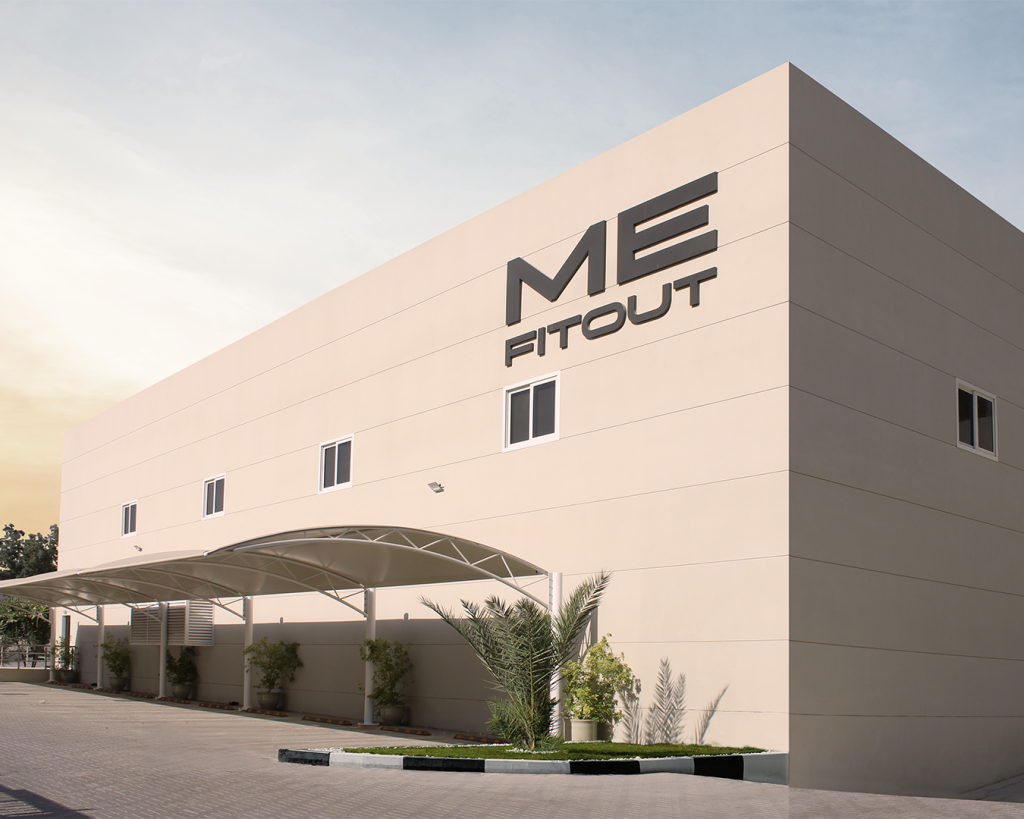
ME FITOUT, a fast-growing interior fit-out company in the UAE, has unveiled a new high-tech, sustainability-driven manufacturing facility in Dubai Investment Park (DIP) to boost the UAE’s booming interior fit-out market projected to reach USD 4.13 billion by 2030. The 100,000-square-foot facility is designed to deliver multiple complex large-scale interior contracting projects, elevating quality, efficiency, and sustainability standards in the sector. Rapid urbanisation and a booming tourism sector have driven growing demand for smart, sustainable, and luxurious environments across the hospitality, corporate, retail, and high-end residential markets in the UAE. ME FITOUT is well-positioned to meet these evolving needs by delivering fully integrated, end-to-end fit-out solutions that support Dubai’s ambition to become a regional hub for design, manufacturing, and sustainable urban development, aligned with the city’s long-term vision for innovation-led economic growth. Sherif Nagy, CEO of ME FITOUT, said: “Our facility marks a new era in how interior contracting should be approached, developed and delivered. We have built a space where technology, sustainability, and craftsmanship converge to meet today’s demand for precision, speed, and design excellence. It’s our commitment to shaping the future of fit-out solutions in the UAE” ME FITOUT is well-positioned to meet these evolving needs by delivering fully integrated, end-to-end fit-out solutions The manufacturing facility is designed for high-output production and has the capacity to simultaneously deliver multiple complex, large-scale projects without compromising on quality or customisation. It features a full suite of next-generation European machinery to support large-scale and highly customised productions. The facility also utilises intelligent recycling systems, material optimisation software, as well as a centralised sawdust collection and disposal process, aligning with the UAE environmental standards. Sherif Nagy added, “The facility’s advanced setup enhances our operational agility, enabling us to maintain consistent quality at scale, adapt seamlessly to evolving project requirements, and significantly reduce operational waste, in an increasingly competitive market. Additionally, our facility is designed to ensure the safety, comfort and well-being of our employees, fostering a secure, supportive, and stress-free environment that empowers productivity and innovation.” Leveraging the combined expertise of highly trained professionals, the plant boasts specialised in-house capabilities across joinery, FF&E, upholstery, glass, solid surfaces, and metalwork, ensuring consistency and excellence across diverse project aspects. Further, the facility is integrated with best-in-class software, ensuring optimised material use, enhanced scheduling accuracy, and real-time workflow management for precision-driven results that align with the stringent timelines of high-profile developments. A key highlight is its dedicated ‘handmade’ division, where skilled artisans craft bespoke woodwork and luxury finishing elements, seamlessly blending traditional craftsmanship with digital manufacturing technologies. The company also leverages Critical Path Methodology (CPM) and real-time production tracking to facilitate agile and accurate scheduling across departments, seamlessly accommodating client needs, urgent modifications, and last-minute requests. The new facility’s launch will consolidate ME FITOUT’s pioneering stature as a leader in the UAE’s design and construction landscape, highlighting its exemplary vision to elevate existing standards of innovation, execution, and luxury craftsmanship in the interior contracting industry. Published by: Design Middle East View Article HERE

